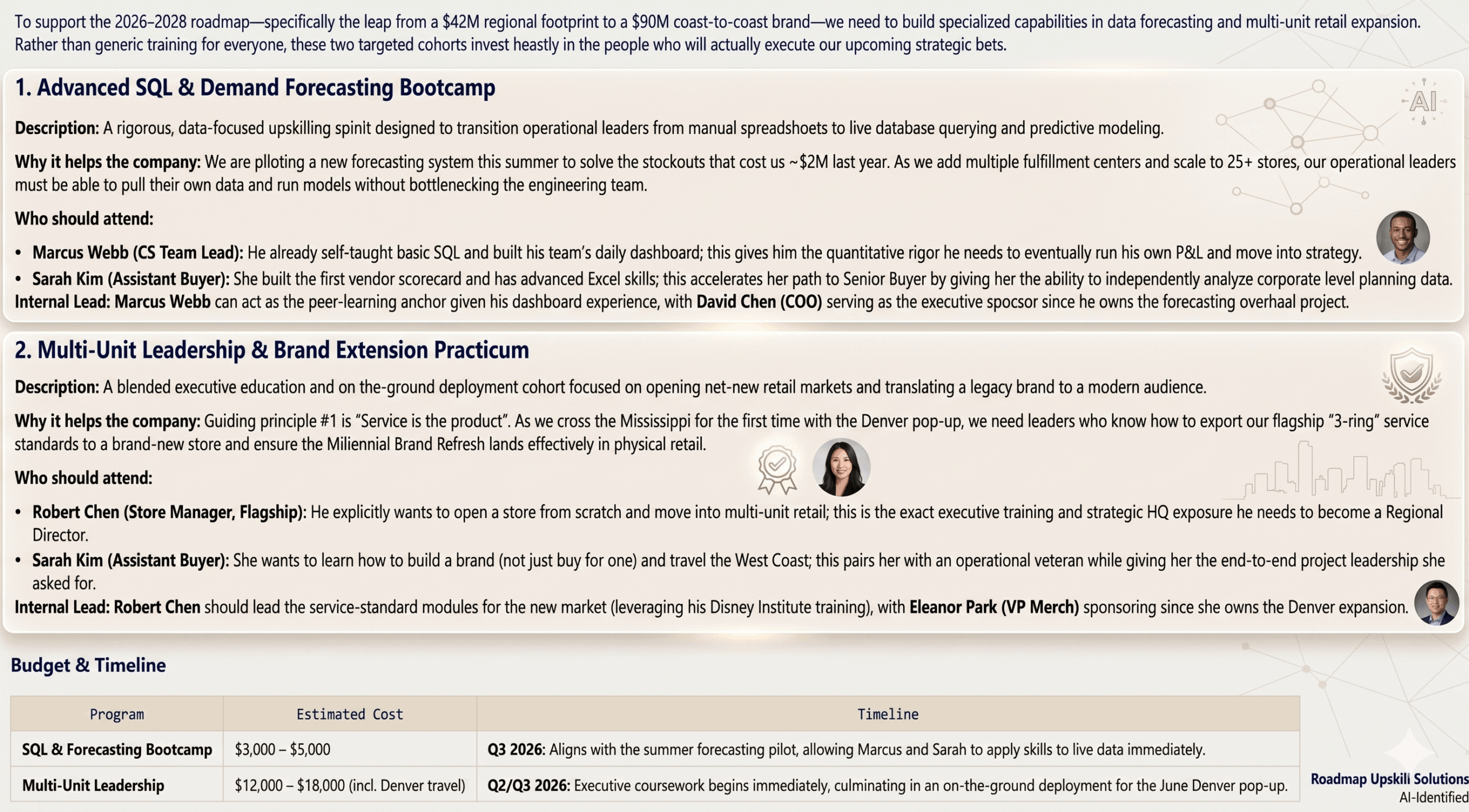
Prefer reading sample AI prompts and example output? I published all files used in this example for easy access and learning.
Want to leave a comment? Join the conversation on my LinkedIn post!
For many employees, the primary workplace frustration isn’t the paycheck – it is the lack of career growth. Research shows that a staggering 94% of employees would stay at a company longer if it invested in their learning and development. Unfortunately, a significant disconnect remains: roughly 59% of workers claim they have received zero formal workplace training, leaving them to self-learn the skills required for their job.
The problem isn’t with lack of managerial support – it is the complexity of execution. While 90% of organizations cite learning opportunities as their top retention strategy, HR departments are struggling with the logistical nightmare of identifying specific skill gaps and coordinating training. Organizations face a “perfect storm” of challenges, including:
- Skill Identification Paralysis: Employees are simply “not sure what they should learn” to stay relevant.
- Operational Friction: Between scheduling conflicts, budget constraints, and a culture that often views training as “time away from real work”, development stays on the backburner.
- Fragmented Systems: Roughly 75% of training managers express dissatisfaction with their own L&D strategies, citing poor user experiences and a lack of human connection in digital-only learning platforms.
Fortunately, AI unlocks a solve for this timeless problem by combining data you already have OR can easily generate:
Leveraging AI to combine your company information (dossier, current projects, roadmap) with your employee information (job description, resume, professional ambitions) provides scalable and immediately actionable opportunities for your employees that benefit your company. Here’s a quick example easily applied to any company.
Company Files
- “About Us” – Whether PowerPoint, Word Doc or website, the AI needs to know about your company’s industry and purpose
- “Roadmap” – The format doesn’t matter; what matters is telling the AI what your company expects to be in three-to-five years
- “Work in Progress” – Although the roadmap is great, understanding the current initiatives is vital for the AI to maximize growth opportunities that benefit current and upcoming projects
Employee Files
For as many employees as possible, three files are needed:
- “Resume” – Because few roles use 100% of any employee’s capabilities, the resume file is important to understand their background and breadth
- “Job Description” – Completing the resume’s picture, knowing the Job Description rounds out the mutual expectations of employee and employer
- “Ambitions” – This is the fun one! Set the expectation that each employee provide a bullet-list of skills, experiences, and opportunities that they want
AI – Bringing It All Together
Once you have those files together, a quick AI prompt – like this – can find the areas to create serendipity in your workforce that delight your employees and accelerate your company:
Based on what you know about my company and my employees, please suggest two training opportunities to offer my employees. Things to keep in mind:
* Focus on skills that will help my company in the near future.
* Prioritize skills where multiple - but not necessarily all - employees can learn and grow together. I'd prefer each training be tremendously beneficial to 25% of my employees than being minimally beneficial to 100% of my employees.

For each training opportunity that you identify:
* Write the title and brief description of each opportunity, plus a couple sentences of why it helps the company
* Provide a bullet list of who should attend and a sentence about why this would benefit them
* If you identify an existing employee (not one who is in attendance) with existing skills in this area who could support or lead the training, mention that.
* Provide a rough budget and timeline, as well as a shortlist of specific external resources that some of the training opportunities will require
Sample Output
By feeding these variables into the model, the output moves from generic advice to targeted growth plans.
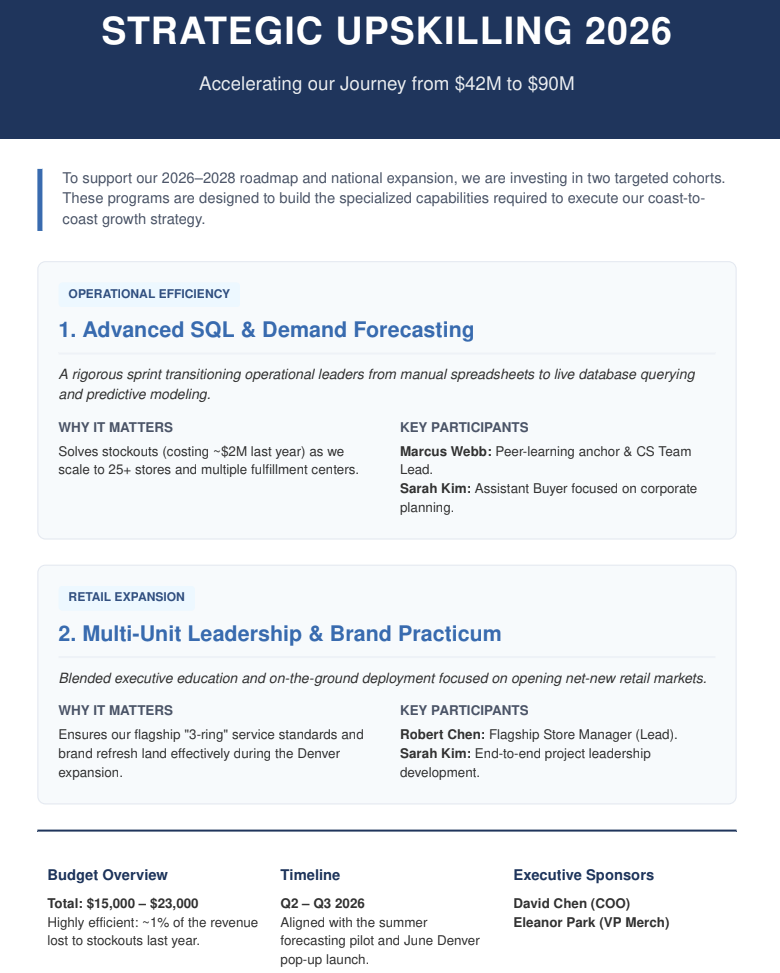
For this example’s fake dataset, the AI suggested two trainings (“Advanced SQL & Demand Forecasting Bootcamp” and “Multi-Unit Leadership & Brand Extension Practicum”). Bringing in cost, timelines and logic makes this training solution sustainable and scalable – fixing the #1 reason most company L&D programs fail.
What’s Next
For my example, I’ve deployed an OpenClaw agent routing to an OpenAI GPT-5.5 model. However, this pattern is platform-agnostic; it works effectively with LangChain, Gemini Enterprise Agent, or other agentic frameworks. The real magic happens when your company and employee files are synced in a secure environment – allowing leadership to receive quarterly, cross-department training suggestions that evolve as the company grows.
Would you like to learn more about using this pattern to help your company? Let me know.